
I Was Wrong
I Was an Evangelical Pastor Who Hated Gay People. Then This Happened.

One of the questions I get asked most often is, “Andy, what changed?” What made a former evangelical pastor, lifelong conservative, and Republican voter completely rethink his views on LGBTQ+ people, politics, faith, and so many of the things I once believed? The answer is not as dramatic as people probably expect. It was not one book, one debate, one political argument, or one perfectly crafted theological takedown. Ultimately, what changed me was kindness.
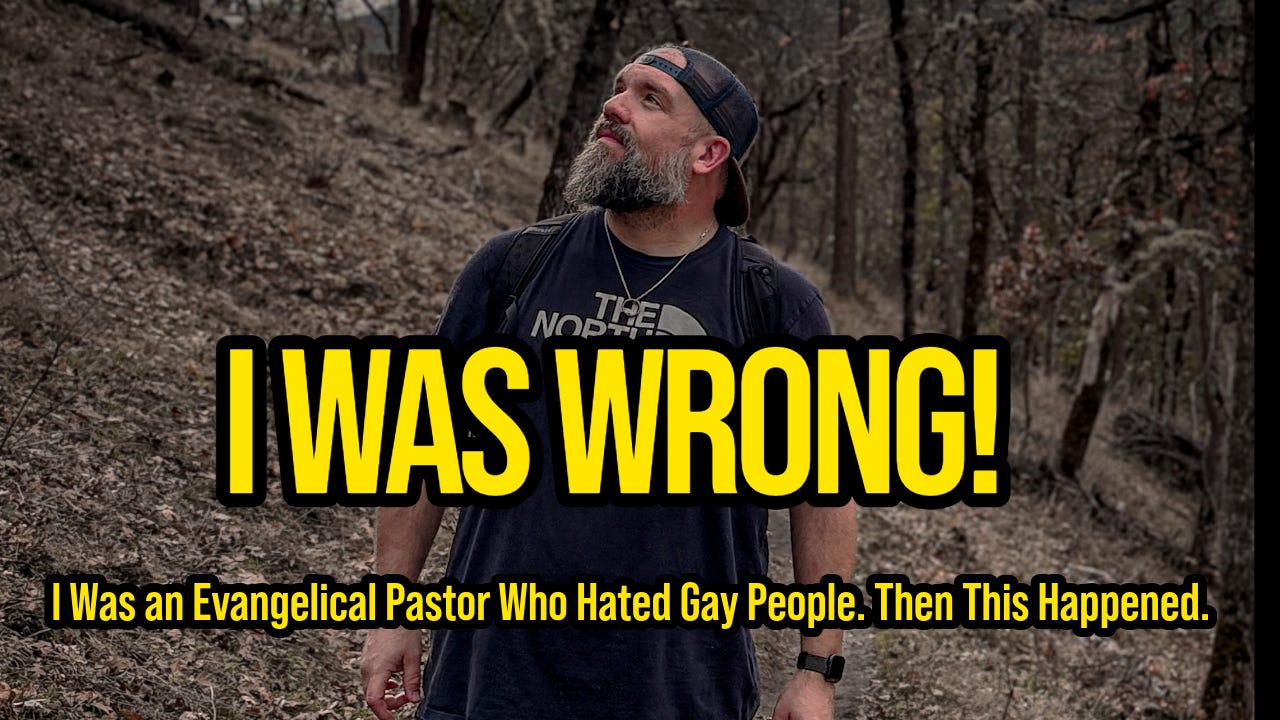
I grew up deep in evangelical Christianity. Both of my parents were preacher’s kids. After my parents separated, church became even more central to my life. I went to Christian school, attended church constantly, accepted Jesus Christ as my personal Lord and Savior, got baptized, and eventually became a pastor myself. By nineteen, I was already working in ministry. I went to Bible college. I spent fifteen years serving in churches. I was also incredibly conservative. I went to Young Republican meetings in high school. I voted for George W. Bush twice. I believed all the things a lot of conservative evangelical kids were taught to believe, not because I had examined them deeply, but because that was the world I was formed in.
Looking back now, I can see that the version of Christianity I was raised in was deeply tied to politics, fear, and judgment. Christianity itself is not the problem, but the strand I came from was judgmental, homophobic, xenophobic, chauvinistic, and more than a little racist. It taught me that certain people were dangerous, certain people were sinful, certain people were threats to the family, the church, and society. LGBTQ+ people were absolutely included in that list. I believed things about queer people that I now deeply regret, and I believed them without ever really listening to the people I was judging.
During those years in ministry, I also worked at Starbucks because, like a lot of pastors, I needed health insurance. Starbucks was really good at the time about offering benefits if you worked enough hours, so while I was preaching and serving in churches, I was also making coffee with people from completely different backgrounds than mine. I worked alongside people of different races, different religions, different political beliefs, women who challenged the way I had been taught to see gender, and people from the LGBTQ+ community. Most of them knew who I was. They knew I was an evangelical pastor. They knew I was Southern Baptist at the time. They knew what I believed. And still, they showed me kindness.
One night, I was closing at Starbucks with a coworker I’ll call Jay. It was pouring rain in Las Vegas, which does not happen very often, and Jay took the bus everywhere. I had only recently gotten a car, and I knew the bus route he would have to take meant standing in the rain, transferring, and probably spending an hour and a half just trying to get home. I could get him there in about twenty minutes, so I told him I would drive him. He lived on a completely different side of town from me, in a part of Las Vegas where, if I’m honest, a lot of white people like me were taught not to hang out. But it was raining, he needed a ride, and it was the obvious thing to do.
When we got to his apartment complex, he paused before getting out of the car and said something I have never forgotten. He said, “Andy, you know, you and I are a lot alike.” And I remember thinking, “What are you talking about?” Jay was a Black gay man. I was a straight white evangelical Christian pastor. In my mind at that time, we could not have been more different. But then he told me his story.
Jay had grown up in the church. He loved God. He wanted to serve God. He had even been preparing for ministry and was being mentored by his pastor. But he was also gay, and in the world we came from, that meant he was taught to hate a part of himself. He tried to pray it away. He tried to become the person his church told him he had to be. Eventually, he went to his pastor and admitted he was struggling and wanted help. Instead of receiving love, kindness, empathy, or support, he was rejected. He told me they called him an abomination. His church kicked him out. His family kicked him out. He was on his own.
What broke me was not just the cruelty of what happened to him. It was what he said after that. He said, “All I wanted to do was serve God.” I sat there realizing that everything I had been taught about people like Jay did not match the human being sitting next to me. He was not dangerous. He was not trying to destroy anything. He was not the caricature I had been handed by church culture and conservative politics. He was a person who had loved God, wanted to serve, and had been thrown away by the very people who were supposed to love him.
I wish I could say I changed completely in that moment, but that would not be honest. What happened was that something cracked. My certainty cracked. My assumptions cracked. The stories I had been handed about LGBTQ+ people started to fall apart because now I had an actual person’s story sitting in front of me. And not just Jay. Over and over again, the people I had been taught to fear kept showing me kindness. They knew what I believed about them, and they were still kinder to me than I had been in my theology, my politics, and my assumptions.
As I continued in ministry, that change kept growing. I had queer teenagers come into my youth groups, and I let them come because they were kids who needed safe adults, community, and support. Some church leaders did not like that. I remember one openly gay teenage girl who was coming to youth group. She had a difficult home life, but she felt safe with us. She was finding positive adults and a place to belong. When we were planning a youth retreat, a pastor told me she could not go because she was gay and would be sleeping in the same quarters as other girls. The implication was ugly and unfair, and even then, I remember thinking, “Dude, what are we doing?”
The more I listened, the more I realized how wrong I had been. I had accepted stereotypes instead of stories. I had accepted fear instead of relationship. I had accepted a version of faith that talked about love while making entire groups of people feel unsafe, unwanted, and disposable. And the people who helped me see that were not people yelling at me from a distance. They were people who let me close enough to see their humanity, even when I did not deserve that grace.
So when people ask what changed me, that is my answer. It was the kindness of queer people. It was the kindness of gay people, trans people, LGBTQ+ people, women, people of color, and people from communities I had been taught to judge before I ever knew them. It was the kindness of people who knew what I believed and still treated me like I was capable of becoming better. I did not deserve that kindness, but they gave it to me anyway.
That is why I try very hard now not to demonize people who are different from me. I know what it feels like to live inside a worldview built on fear. I know what it is like to believe harmful things because everyone around you tells you they are true. And I also know what it is like to have your life changed because someone you were taught to fear chooses to show you compassion.
I am not saying everyone has to leave Christianity. I am not saying everyone has to stop believing in God. But I am saying that if your faith requires you to treat people without dignity, love, and respect, then something is deeply wrong. Who someone loves, how someone identifies, where someone comes from, or whether they fit neatly inside the box you were handed should never determine whether they are worthy of being treated like a human being.
We are all worthy of dignity, love, and respect. No exceptions. And the people I was taught were the most different from me turned out to be far more like me than I ever imagined. Their kindness changed my life.